
Understanding debtors and creditors is critical for your business cash flow, financial reporting, and avoiding costly accounting mistakes.
A debtor is anyone who owes your business money a customer who purchased on credit. A creditor is anyone your business owes money to a supplier or lender waiting to be paid.
These two concepts control every credit transaction your business makes. Get them wrong, and your balance sheet becomes unreliable. Get them right, and you’ll predict cash flow accurately, avoid bad debt surprises, and make smarter financial decisions.
What Are Debtors and Creditors?
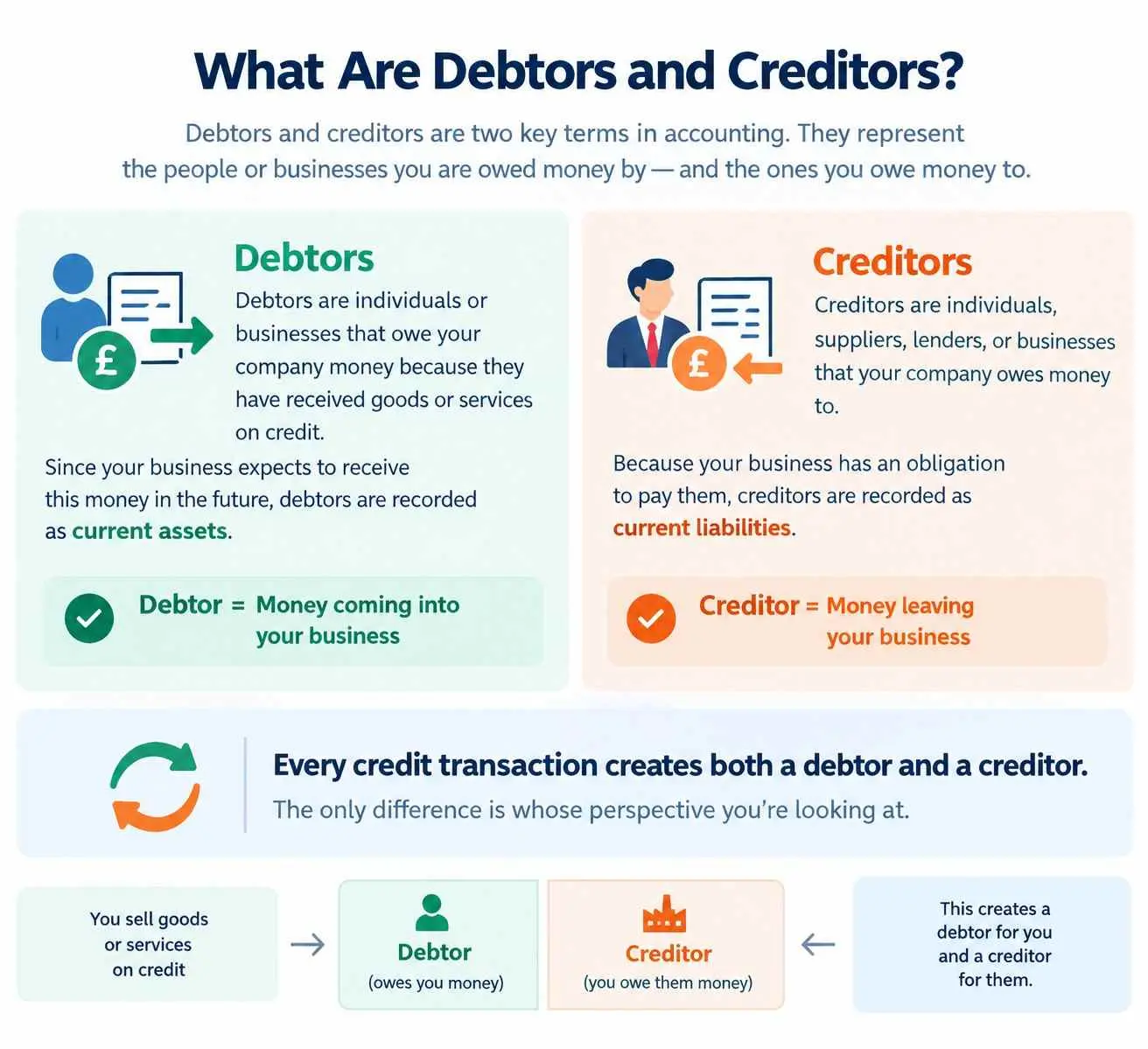
Debtors and creditors meaning in accounting. Debtors are individuals or businesses that owe your company money because they have received goods or services on credit. Since your business expects to receive this money in the future, debtors are recorded as current assets.
Creditors, on the other hand, are individuals, suppliers, lenders, or businesses that your company owes money to. Because your business has an obligation to pay them, creditors are recorded as current liabilities.
Simply put:
- Debtor = Money coming into your business
- Creditor = Money leaving your business
Every credit transaction creates both a debtor and a creditor. The only difference is whose perspective you’re looking at.
Quick Comparison: Debtors vs Creditors
| Aspect | Debtors | Creditors |
| Definition | Customers who owe you money | Suppliers you owe money to |
| Accounting Term | Accounts Receivable | Accounts Payable |
| Balance Sheet | Current Asset | Current Liability |
| Cash Flow | Money coming IN to your business | Money going OUT from your business |
| Risk Type | Bad debts (non-payment) | Late payment penalties & cash shortage |
| Example | Customer buys goods on 30-day terms | Supplier delivers stock, invoices for payment later |
| Record Keeping | Track customer payment history | Track supplier payment deadlines |
Simple Memory Rule: Debtors bring cash in. Creditors take cash out.
What Is a Debtor? (Definition and Examples)
Debtor Definition in Accounting
A debtor is an individual, business, or organisation that has received goods or services from your company without paying immediately.
Instead, they’ve been granted a credit period (typically 14, 30, 60, or 90 days) to settle the invoice.
Until payment arrives, that debtor appears on your balance sheet as a current asset under “Accounts Receivable.”
Key Point: Debtors = money your business expects to receive soon.
Real-World Debtor Examples
- Construction/Trades: A plumbing company completes work for a homeowner on 30-day terms
- Wholesale/Retail: A shop purchases stock from a manufacturer with 60-day payment terms
- Professional Services: An accounting firm bills a client after completing tax returns (payment due within 14 days)
- B2B: A software company delivers a customised system and invoices the client on net-30 basis
- Non-Profit/Government: A freelancer invoices a local council for services; payment may take 30+ days due to procurement rules
Each customer or client becomes a debtor from the moment you invoice them until payment clears your bank account.
How Debtors Affect Cash Flow
A high debtor balance = customers owe you significant money = potential cash shortage for your business, even with strong sales.
Real scenario: A business with £50,000 in monthly sales but 60-day average debtor payment = £100,000 tied up in receivables. That’s capital you can’t use to pay suppliers or staff.
Types of Debtors
Although many people think only of customers, businesses may have several types of debtors.
Trade Debtors
Trade debtors are customers who purchase products or services on credit during normal business operations.
Examples include:
- Retail customers
- Business clients
- Corporate customers
- Wholesale buyers
These are usually the largest category of debtors.
Non-Trade Debtors
Non-trade debtors arise from transactions that are not part of normal sales activities.
Examples include:
- VAT refunds
- Employee advances
- Insurance claims
- Tax recoveries
- Interest receivable
Although these amounts are still owed to your business, they do not come from ordinary trading activities.
Loan Debtors
If your business lends money to another organisation or employee, the borrower becomes a debtor until the loan is repaid.
What Is a Creditor?
A creditor is any person, supplier, lender, or organisation that your business owes money to because goods, services, or financing have already been received.
Instead of paying immediately, your business agrees to pay within a specified credit period.
Until payment is made, the balance is recorded under Accounts Payable.
Extra Reading: What is a Creditor in Accounting
Examples of Creditors
Suppose your business purchases office furniture worth £4,000 from a supplier with payment due in 30 days.
The supplier becomes your creditor.
Similarly, if:
- You receive accounting services before paying
- Purchase inventory on credit
- Hire marketing services with payment due later
- Receive legal services before payment
those service providers become your creditors.
Types of Creditors
Trade Creditors
Trade creditors are suppliers who provide products or services directly related to your business operations.
Examples include:
- Inventory suppliers
- Manufacturers
- Wholesalers
- Printing companies
- Packaging suppliers
Non-Trade Creditors
These arise outside normal trading activities.
Examples include:
- HMRC tax liabilities
- Utility bills
- Rent payable
- Insurance premiums
- Professional service invoices
- VAT payable
Loan Creditors
Banks, finance companies, and other lenders become creditors whenever they lend money to your business.
Examples include:
- Bank loans
- Equipment finance
- Commercial mortgages
- Director loans
- Business overdrafts
How Debtors and Creditors Appear on the Balance Sheet
This is where exam questions get tricky, so pay close attention.
On the Balance Sheet, debtors sit under current assets because that money is coming in soon. Creditors sit under current liabilities because that money is going out soon.
Here is the simple rule:
- Debtor = Asset (money coming to you)
- Creditor = Liability (money you must pay)
If you remember nothing else about debtors and creditors, remember this one line. It solves most confusion instantly.
Extra Reading: Sole Trader Accountant
Debtors and Creditors in Business Transactions
Every credit sale or purchase creates a paper trail. Let’s look at basic journal entries so you can see how debtors and creditors move through the books.
When a Sale Happens on Credit
Debit: Debtor’s Account Credit: Sales Account
The debtor now owes you money, so their account is debited to show a rise in what they owe.
When a Purchase Happens on Credit
Debit: Purchases Account Credit: Creditor’s Account
Here, the creditor’s account is credited because your liability just went up.
These small entries repeat thousands of times across any growing business. Getting them right keeps your Business Transactions accurate and your reports trustworthy.
Can a Business Be a Debtor and a Creditor to the Same Party? (Contra Accounts & Set-Off)
Yes, and it happens more than most business owners realise. A printer who buys stationery from you but also prints your leaflets is your creditor for the leaflets and your debtor for the stationery, at the same time, on the same account.
The question that actually matters is whether you can net these into one figure. Most people assume yes. The rule says otherwise.
You can only net them if a genuine contractual right of set-off exists. Without one, FRS 102 requires both balances to be shown gross. “Netting for tidiness” isn’t a shortcut, it’s a misstatement that quietly understates both your assets and your liabilities.
Worked example: Business A owes Supplier X £4,000 for stock. Supplier X owes Business A £1,500 for contract work.
| Approach | Entry |
|---|---|
| Wrong (netted without a set-off right) | Supplier X: £2,500 net |
| Correct (gross, no legal set-off) | Creditor £4,000 / Debtor £1,500 shown separately |
Only where a real set-off agreement exists can these legitimately be combined for presentation.
Where this bites in practice:
- Group/intercompany accounts, where common ownership makes netting tempting and scrutiny should be highest.
- Invoicing software that auto-matches opposing balances on the same supplier code, no one decides to net, it just happens, until an auditor asks why gross receivables and payables don’t reconcile.
The takeaway: debtor and creditor aren’t fixed identities, they’re relationships. Whether you can collapse two balances into one depends on the legal right to do so, not on convenience.
Accounts Receivable vs Accounts Payable
Many students confuse these terms with debtors and creditors, and honestly, they are closely linked.
- Accounts Receivable is the total amount owed by all your debtors combined
- Accounts Payable is the total amount you owe to all your creditors combined
Think of debtors and creditors as the people. Think of receivable and payable as the total balances those people create in your books.
Credit Transactions and Financial Obligations
Credit Transactions are simply any deal where payment is delayed instead of made on the spot. They build trust between buyers and sellers, but they also create risk.
Every credit transaction creates a Financial Obligation for one party and an asset for the other. That is the entire logic behind debtors and creditors. One side must pay. The other side must collect.
A business that manages these obligations well protects its cash flow. A business that ignores them often runs into trouble, even while showing healthy sales on paper.
Easy Memory Tricks to Remember the Difference
Struggling to remember which is which? Try these tricks.
- D for Debtor, D for money Due to you
- C for Creditor, C for Cash you owe
- Picture a debtor as someone who “owes” you, like a friend who borrowed your notes and has not returned them
- Picture a creditor as the shop you still need to pay for your notebook
These small tricks help during exams when your mind goes blank under pressure.
Best Accounting Software for Debtor/Creditor Management
1. Xero (Most Popular for UK SMEs)
Best for: Growing businesses with 10-100 customers
Key Features:
- Automatic payment reminders (customers)
- Debtor aging reports (shows who owes what & how overdue)
- Creditor alerts (you never miss a payment deadline)
- Multi-currency support
- Bank reconciliation (automatic)
- Integration with payment processors (GoCardless, Stripe, PayPal)
How it helps: Xero sends automatic email reminders to your customers when invoices are due, reducing late payments by 30-50%
Cost: £20-60/month depending on features.
2. QuickBooks Online
Best for: Freelancers and micro-businesses (1-10 invoices/month)
Key Features:
- Simple invoice tracking
- Expense categorization
- Automatic invoice reminders
- Time tracking (if you bill by hours)
- Mobile app
How it helps: QuickBooks automatically categorizes transactions, so you spend less time organizing data
Cost: £10-30/month
Why consider it: Simpler than Xero, cheaper, but less powerful for complex businesses
3. Sage 50
Best for: Established businesses (50+ transactions monthly)
Key Features:
- Desktop software (works offline)
- Advanced debtor management
- Creditor payment planning
- Multi-user (team access)
- Stock control (if applicable)
How it helps: Sage integrates with your banking system and can automatically match payments to invoices
Cost: £35-50/month + setup
Why consider it: If you have complex inventory or multiple users, Sage is powerful
4. Freshbooks
Best for: Service businesses (consulting, agencies, contractors)
Key Features:
- Beautiful invoice templates (professional appearance)
- Automatic payment reminders (very effective)
- Time tracking integration
- Expense tracking
- Limited accounting functions
How it helps: Studies show professional invoices get paid 30% faster. Freshbooks templates look premium
Cost: £12-40/month.
Extra Reading: How Much Should a Small Business Pay for Accounting Services?
Common Mistakes Students and Small Business Owners Make
- Mixing up which side of the ledger a debtor sits on
- Forgetting that a debtor is an asset, not a liability
- Recording a credit purchase as if it was a cash purchase
- Not tracking overdue debtors, which leads to bad debts
- Ignoring supplier payment terms, which damages creditor relationships
Avoiding these mistakes keeps your accounts clean and your exam answers accurate.
Final Thoughts
Understanding debtors and creditors is not just an exam topic. It shapes how every business tracks cash, plans payments and stays financially healthy.
Once you know that a debtor brings money in and a creditor takes money out, the rest of accounting starts to click into place.
At White Weaver Accountants, we help small businesses and students make sense of their books, manage receivables and payables, and stay on top of every credit transaction. If you need help managing your debtors and creditors or want clear, jargon-free bookkeeping support, Contact us today.
Frequently Asked Questions
What is the simple meaning of debtors and creditors?
A debtor owes money to a business. A creditor is owed money by a business. Together they represent the two sides of every credit transaction.
Is a debtor an asset or a liability?
A debtor is an asset because the business expects to receive that money soon.
Is a creditor an asset or a liability?
A creditor is a liability because the business must pay that money soon.
Can a business be both a debtor and a creditor at the same time?
Yes. A business can owe money to suppliers while also being owed money by customers, both at once.
What is the difference between debtors and accounts receivable?
Debtors are the individual people or businesses who owe money. Accounts receivable is the total balance of everything all debtors owe combined.